What Should Buyers Check in TPU PPF?
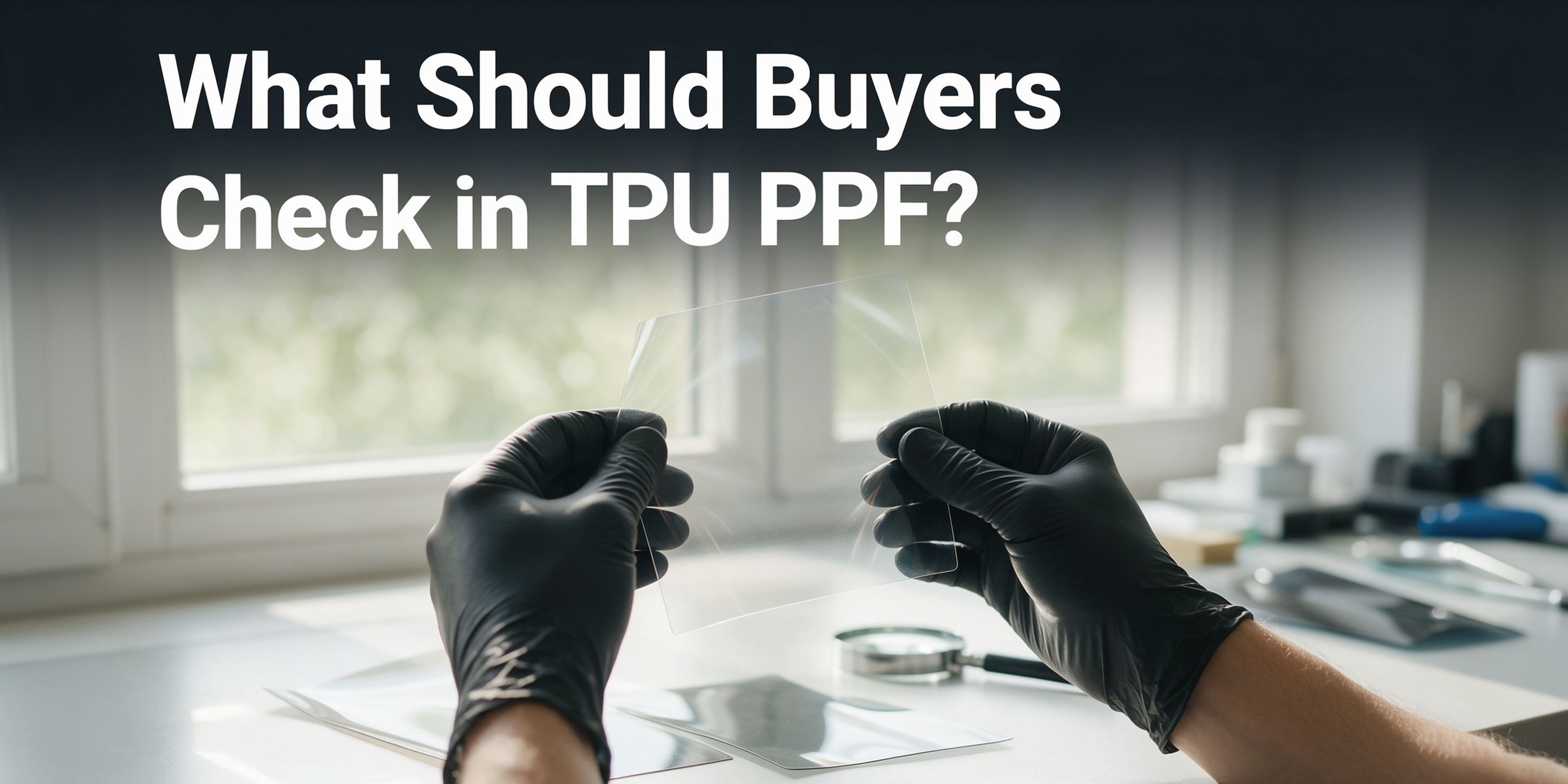
Quick Answer: What Should Buyers Check in TPU PPF?
Before ordering TPU paint protection film (PPF), buyers should check eight key areas: product identity, film construction, thickness measurement, coating performance, adhesive and installation behavior, technical documents, sample quality, and quality-control and warranty terms.
The most important principle is to make sure the information refers to the exact product model being quoted. A specification sheet, test report, sample, and warranty document should not be treated as interchangeable evidence. Each serves a different purpose in evaluating a film.
This checklist is designed for distributors, importers, professional installers, and automotive film brands that need to assess TPU PPF before placing an order.
1. Confirm the Exact Product Model
Start with the product name, model code, and specification in the quotation. Before reviewing performance claims, confirm that the documents and sample you receive relate to the same product.
A supplier may offer multiple PPF models with different thicknesses, constructions, finishes, or performance characteristics. Information about one model should not automatically be applied to another.
Check the following details:
-
Product name and model code.
-
Clear or colored finish, where applicable.
-
Stated thickness and roll dimensions.
-
Product construction and available options.
-
Consistency between the quotation, technical data sheet, sample label, and other supporting documents.
If any information differs, ask the supplier to explain the difference in writing before proceeding. This simple check helps prevent confusion when comparing quotations or confirming an order.
2. Check the Film Construction
Understanding the film structure helps buyers identify what they are purchasing and compare products more accurately.
Depending on the model, a TPU PPF may include a surface coating, TPU film, adhesive layer, and release liner. The exact construction can vary, so request the structure for the specific product rather than relying on a general description of the product category.
Ask the supplier:
-
What material is used for the base film?
-
What are the main layers in this model?
-
What information is available about the coating and adhesive?
-
Does the stated construction match the sample and quoted product?
-
Which parts of the structure are included in the total thickness?
Do not assume that every TPU film has the same formulation or structure. A clear explanation of the construction gives buyers a better basis for asking further technical questions.
3. Verify How Thickness Is Measured
Thickness is useful for comparing product specifications, but only when the values are measured and described on a comparable basis.
One mil equals 25.4 micrometers (µm). However, the stated thickness may refer to different parts of the film structure depending on the supplier's measurement method. Confirm whether the figure represents the base film, the film with its coating and adhesive, or another defined configuration.
Before comparing two products, ask:
-
What exactly does the stated thickness include?
-
Which measurement method is used?
-
Is the value specified for the exact model being quoted?
-
Are measurement tolerances or supporting records available?
Do not assume that a higher thickness number automatically means better overall performance. Thickness should be evaluated together with construction, installation characteristics, and relevant performance evidence.
4. Check the Topcoat and Performance Claims
The topcoat is an important part of a PPF's surface. Buyers may encounter claims relating to self-healing, gloss retention, stain resistance, scratch resistance, or weathering performance.
These terms should be understood individually. For example, self-healing generally describes the recovery of certain minor surface marks under specified conditions. It does not mean that deep scratches, cuts, or all forms of damage will disappear.
Ask which properties are claimed for the exact model and what evidence is available to support them. Where relevant, check whether the supplier explains the test method, conditions, and limitations.
A useful review should distinguish between three things:
-
A feature described in the product literature.
-
A result demonstrated under a stated test method.
-
A performance expectation under real installation and use conditions.
These are related, but they are not the same. Buyers should avoid relying on broad marketing terms when making decisions about product suitability or making claims to their own customers.
5. Evaluate the Adhesive and Installation Behavior
The adhesive system and the way a film behaves during installation are important considerations for professional buyers.
A product's appearance before installation does not tell you everything about how easily it can be applied, positioned, stretched, or finished around curved areas. Installation performance should be evaluated using the supplier's guidance and, where possible, practical sample testing.
Ask the supplier for:
-
Recommended installation procedures.
-
Available instructions for positioning and handling the film.
-
Guidance for curved panels and edge finishing.
-
Relevant information about adhesion and removal.
-
Any known limitations for the intended application.
Use a trained installer when assessing samples. Observe handling, conformity, edge finishing, and the final appearance under consistent conditions.
Avoid judging the adhesive by a single statement such as "high adhesion." The appropriate behavior depends on the product and how it is designed to be installed and used.
6. Review the Technical Documents Carefully
Technical documents help buyers understand the stated specifications and evaluate whether performance claims are supported. However, different documents serve different purposes.
| Document | What It Helps You Check |
|---|---|
| Technical Data Sheet (TDS) | Stated product specifications and properties |
| Test report | Results for identified specimens tested under stated conditions |
| Safety Data Sheet (SDS), where applicable | Relevant information about material handling and safety |
| Installation guide | Recommended procedures and usage conditions |
| Warranty document | Coverage, exclusions, duration, and claim procedures |
| Management-system certificate, where relevant | The management system and scope identified by that certificate |
A TDS is not the same as a test report, and a management-system certificate does not automatically prove every performance claim about a finished film.
When reviewing a test report, check the product identification, test method, conditions, results, and date where provided. If the tested specimen has a different model code or construction from the quoted film, ask the supplier to clarify the relationship.
Do not assume that a report for a raw TPU material, a different film model, or a different construction automatically verifies the performance of the finished product you plan to purchase.
For importers and distributors, this document review can also reveal which product questions remain unanswered before ordering.
7. Inspect the Sample and Record the Results
A sample provides an opportunity to assess the actual product rather than relying only on descriptions and photographs.
Before testing, confirm the sample's model and compare its specifications with the quotation. If possible, use the same evaluation process for every product being considered.
A practical checklist may include:
-
Appearance: Check whether the surface finish matches the stated product type.
-
Handling: Observe how the film behaves during the intended installation process.
-
Conformity: Evaluate how it follows suitable curved test areas.
-
Edges: Check the finish around edges and other challenging areas.
-
Documentation: Record the model, stated specifications, and any questions arising from the evaluation.
Keep notes and photographs where appropriate, and ask the supplier to respond to specific concerns. If the sample meets your requirements, confirm that the future order will use the agreed product model and specifications.
Sample testing alone cannot guarantee that future batches will be identical. It should be considered alongside the supplier's quality-control arrangements and batch identification practices.
8. Check Quality Control, Warranty, and Order Terms
The final check is whether the supplier can clearly explain how the product is controlled, what support is available, and what both parties are agreeing to purchase.
Ask how product specifications are checked, how batches are identified, and what records can be provided. For repeat orders, clarify how the supplier manages consistency and communicates changes to the product or its specifications.
Warranty terms should be reviewed for the exact model. Confirm the duration, covered issues, exclusions, conditions, and claim process in writing. Do not assume that the warranty for one product applies to every film in the supplier's range.
Also confirm the commercial details that affect the actual order:
-
Minimum order quantity and available roll dimensions.
-
Quotation currency, validity, and unit of sale.
-
Estimated production or dispatch lead time.
-
Packaging and any agreed customization.
-
Payment and delivery terms.
-
Available after-sales and technical support.
Clear written terms help both parties understand what will be supplied and how issues will be handled if questions arise later.
A Quick TPU PPF Buyer Checklist
Before confirming your order, use this summary to identify missing information.
| Checkpoint | Confirmation Needed |
|---|---|
| Product identity | The quoted model, sample, and documents match |
| Film structure | The main layers are clearly explained |
| Thickness | The measurement basis is defined |
| Performance claims | Relevant evidence and limitations are understood |
| Adhesive and installation | Guidance is available for the intended application |
| Technical documents | Each document matches its stated purpose and scope |
| Sample evaluation | Results and outstanding questions are recorded |
| Quality and warranty | Quality controls, coverage, and commercial terms are clear |
If important information is missing, ask specific follow-up questions rather than assuming that the product meets your requirements.
Frequently Asked Questions
Is a TDS enough to verify TPU PPF quality?
Not by itself. A Technical Data Sheet summarizes stated product information, while a test report records results obtained under particular test conditions. Buyers should review each available document according to its purpose and confirm that it applies to the exact product model.
Why should the product model match across documents and samples?
Different models may have different constructions or specifications. Matching the model code across the quotation, technical documents, sample, and agreed order helps reduce the risk of evaluating one product and receiving another.
Should I compare TPU PPF thickness by the number alone?
No. First confirm which layers are included and how the thickness is measured. Then compare specifications using the same measurement basis and consider the product's intended application and other relevant characteristics.
What should I check when testing a TPU PPF sample?
Confirm the sample model and specifications, then assess appearance, handling, conformity, edge finishing, and other characteristics relevant to your installation process. Record the test conditions and discuss any concerns with the supplier.
Does a longer warranty always mean better TPU PPF?
Not necessarily. Buyers should review the written warranty's scope, exclusions, conditions, and claim procedure for the exact model. A longer stated period should not replace an assessment of product documentation, sample suitability, and available performance evidence.
What should I do if a test report does not match the quoted model?
Ask the supplier to explain the difference and provide documents applicable to the exact product being considered. Do not assume that a report for another model or material automatically verifies the quoted product.
Conclusion: Verify the Details Before You Order
Checking TPU PPF before purchasing means confirming that the product identity, construction, specifications, performance information, sample, and commercial terms all make sense together.
A careful review helps distributors, importers, professional installers, and automotive film brands compare options more consistently and identify unanswered questions before committing to an order.
If you are evaluating TPU PPF for distribution, installation, or a private-label project, contact Guangdong Aici New Materials Co., Ltd. to discuss your requirements and request available product information. Sharing your intended application, target market, preferred specifications, and estimated order quantity will help the team understand your needs and explore suitable options.
TPU PPF Thickness: What Buyers Need to Know
How to Choose a TPU Paint Protection Film