How to Choose a TPU Paint Protection Film

Quick Answer: How Do You Choose a TPU Paint Protection Film?
To choose a suitable TPU paint protection film (PPF), start by defining your intended application, target market, and performance requirements. Then compare the film's material and layer structure, thickness measurement, topcoat, adhesive, appearance, installation behavior, available test evidence, and warranty terms.
For distributors, importers, and professional installers, the best choice is not necessarily the thickest or most expensive film. It is the product whose verified specifications, installation characteristics, and commercial terms match the needs of your customers.
1. Define Your Application: Clear PPF or Color PPF?
Before comparing technical specifications, decide what the film is expected to do.
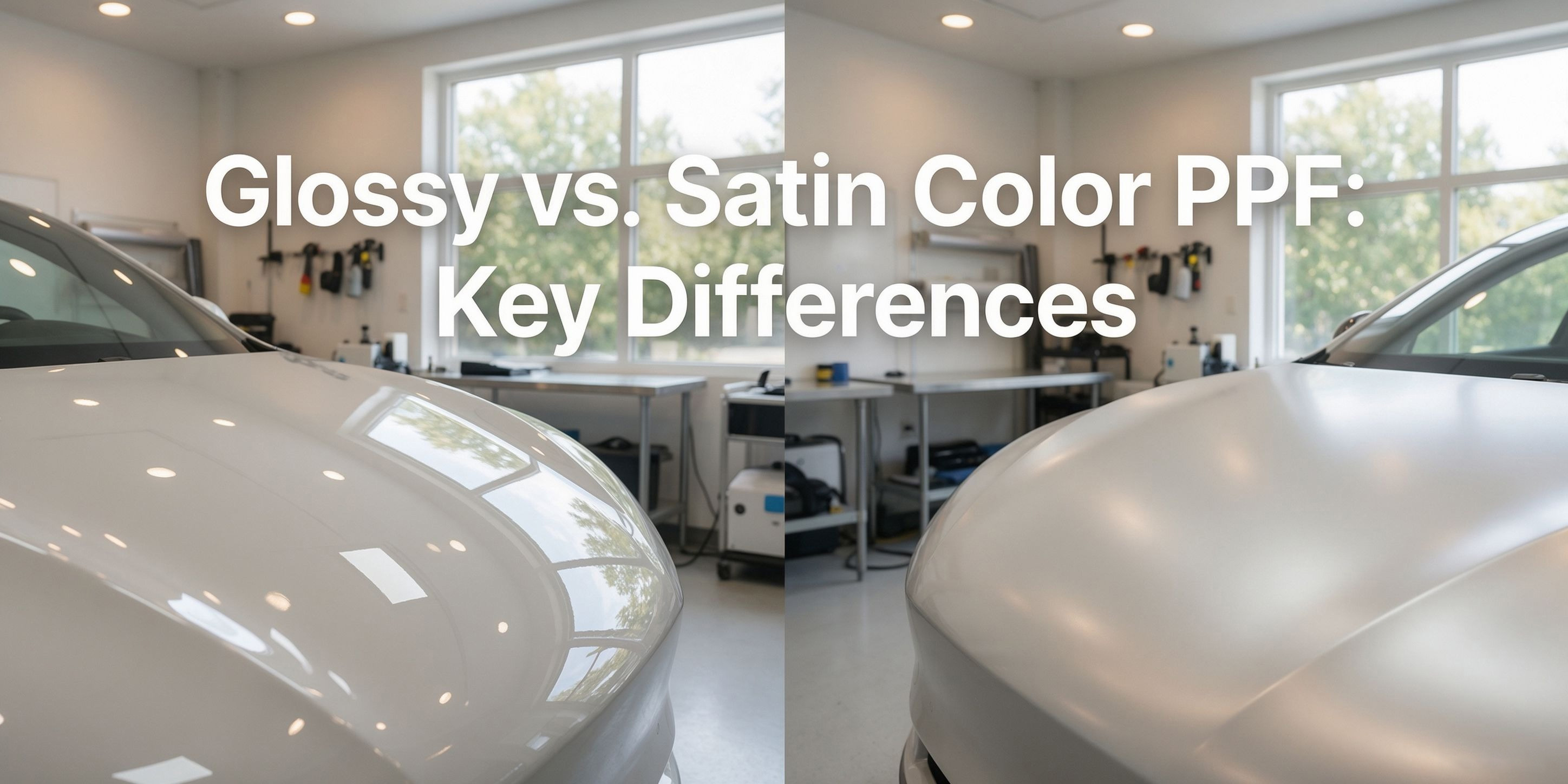
Clear PPF is primarily selected to help protect a vehicle's original paint while preserving its existing color and appearance. Color PPF combines paint protection with a different exterior finish, making it an option for buyers seeking both protection and a change in vehicle appearance.
PVC color change film is another product category, generally selected primarily for changing a vehicle's color or finish. It should not automatically be treated as equivalent to TPU paint protection film. Buyers should compare products according to their intended function rather than relying on terms such as "car wrap" alone.
For professional buyers, the decision should begin with a few practical questions:
-
Are your customers mainly looking for paint protection, a new color, or both?
-
Which finishes and product types are relevant to your target market?
-
What installation requirements and price positioning do your customers expect?
-
Are you sourcing a product for retail sales, professional installation, distribution, or a private-label brand?
Clearly defining the application makes it easier to narrow down the available products and avoid comparing films designed for different purposes.
2. Check the TPU Material and Film Structure
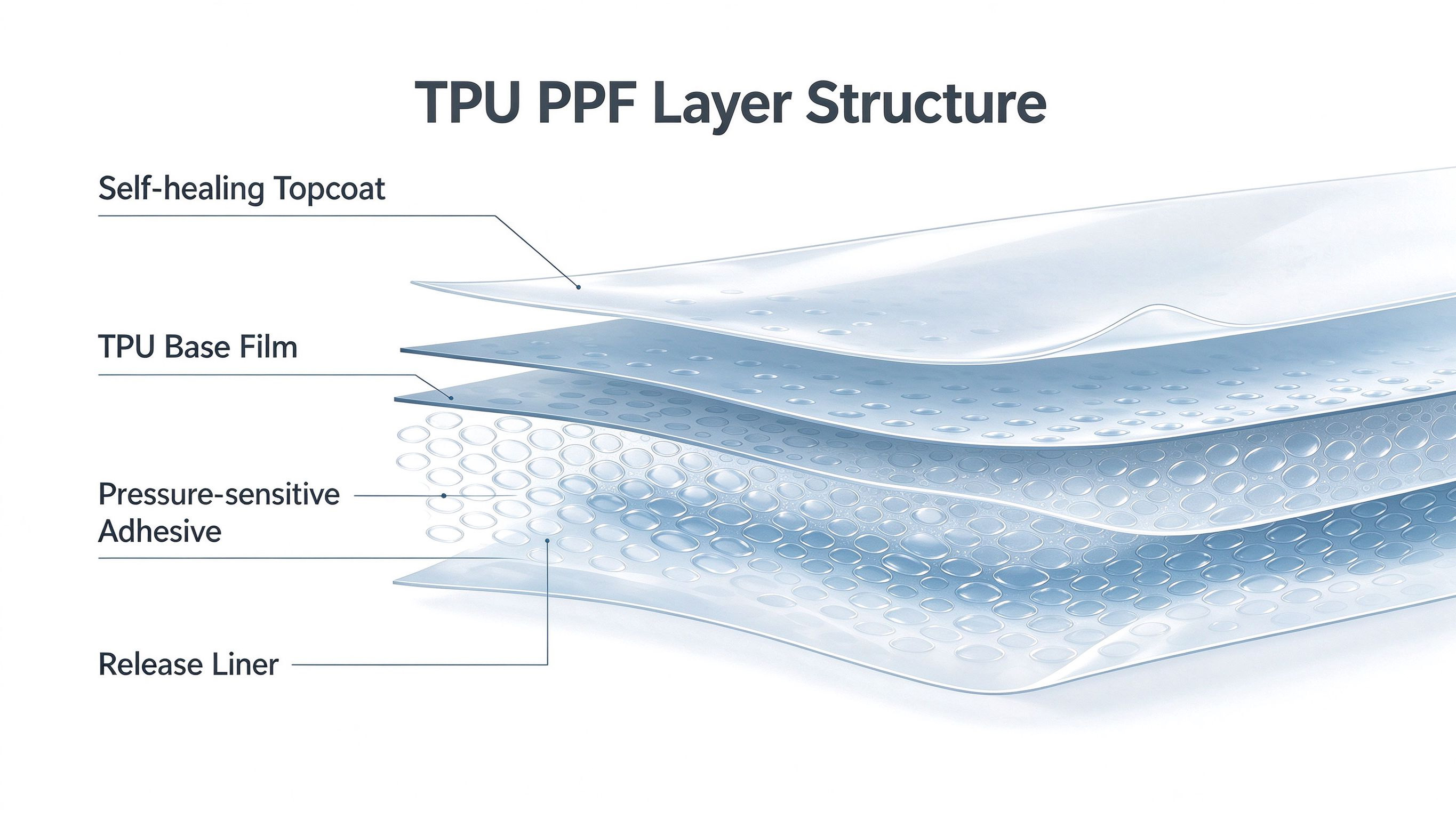
The term TPU stands for thermoplastic polyurethane. However, knowing that a film uses TPU does not tell you everything about its finished performance.
A TPU PPF product may contain several functional layers, including a surface topcoat, a TPU base film, an adhesive layer, and a release liner. The exact construction can vary by product series. Color PPF may use a different layered design from transparent PPF, so buyers should request the structure of the specific model under consideration.
When evaluating a product, ask for:
-
A clear description or diagram of the film structure.
-
The base material and the specifications of the actual product model.
-
Information about the topcoat and adhesive system.
-
Confirmation of which layers are included in the stated thickness.
-
Technical documents that correspond to the model being quoted.
Do not judge a finished film by one material label alone. The complete construction, formulation, manufacturing consistency, and suitability for the intended application all matter.
For distributors developing a product range, understanding these details also helps explain the differences between product grades and select options that fit different customer needs.
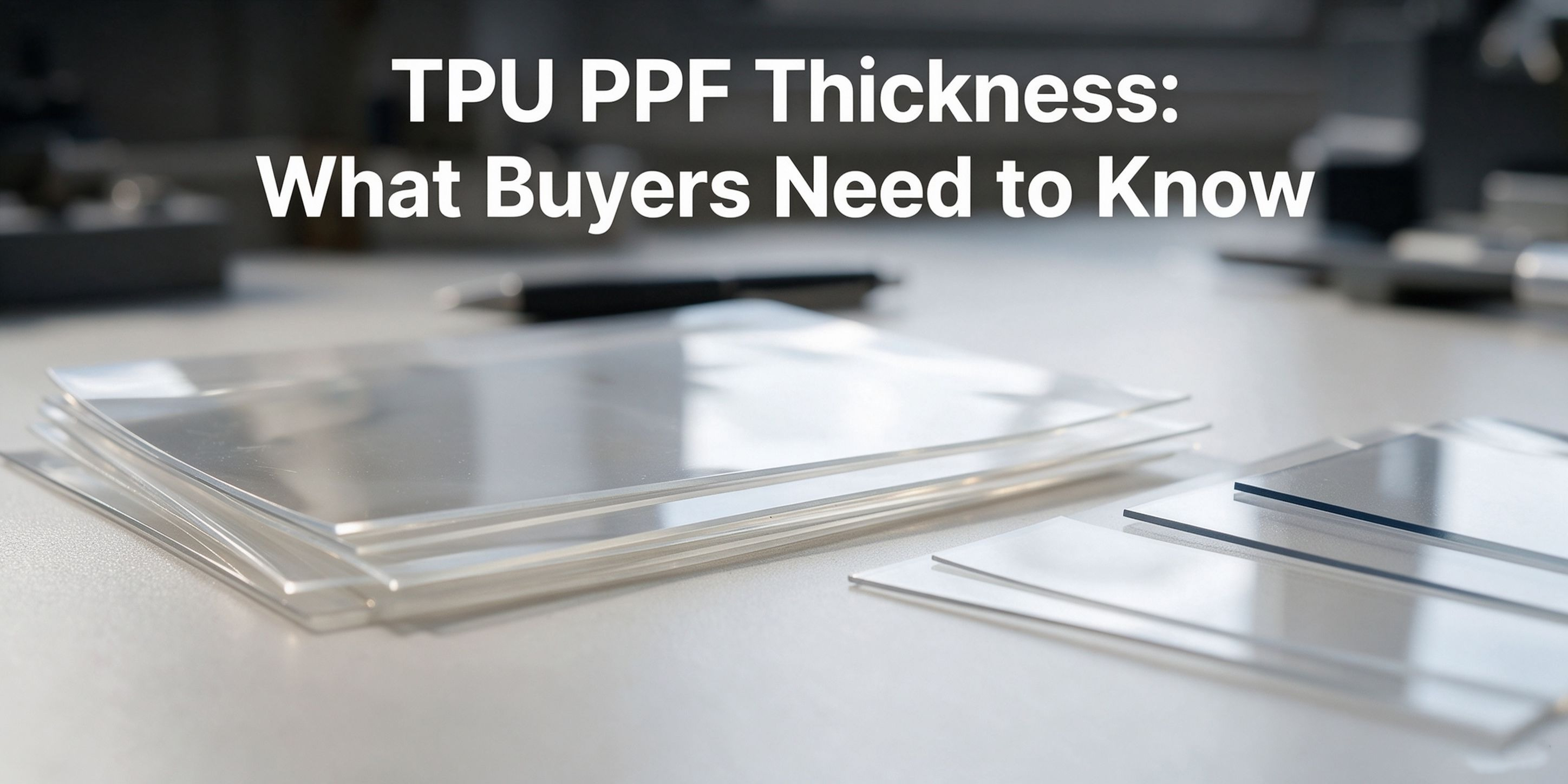
3. Compare Thickness Correctly
Thickness is an important specification, but a larger number does not automatically mean a better product.
When comparing TPU PPF, first confirm how the supplier measures thickness. The stated value may include different parts of the film construction depending on the supplier's specification method. Ask whether the figure refers to the base film alone or the complete film structure, and how the coating and adhesive are treated in that measurement.
One mil equals 25.4 micrometers (µm). If suppliers use different units, convert the values before comparing them. More importantly, make sure they are reporting thickness on a comparable basis.
Consider these questions:
-
What is the stated total thickness, and how is it measured?
-
Is the thickness specification model-specific?
-
Are tolerances or measurement methods documented?
-
How does the thickness relate to the product's intended use and installation requirements?
A suitable thickness should be considered together with flexibility, conformity to curved panels, handling characteristics, and available performance evidence. Do not select a film based on thickness alone.
For B2B buyers, a consistent method of comparing specifications makes supplier quotations easier to evaluate and reduces the risk of misunderstandings during ordering.
4. Evaluate the Topcoat and Surface Performance
The topcoat is an important part of a paint protection film because the surface interacts directly with everyday environmental exposure and cleaning.
Depending on the product, suppliers may describe characteristics such as gloss retention, stain resistance, resistance to surface marks, or self-healing behavior. These terms should be evaluated individually rather than treated as a single measure of quality.
For example, self-healing generally refers to the ability of a suitable surface coating to recover from certain minor marks under specified conditions. It does not mean that every scratch, cut, or impact will disappear.
Before choosing a product, ask:
-
What surface characteristics is the product designed to provide?
-
What types of minor marks, if any, can the topcoat recover from?
-
Does the recovery process require heat or other specific conditions?
-
What evidence supports the stated surface performance?
-
Are there limitations that installers or end users should understand?
A supplier's explanation should be consistent with the actual product specifications and supporting evidence. Avoid assuming that two films with similar marketing descriptions will perform identically.
For distributors and brands, this information is also useful when preparing accurate product descriptions and setting customer expectations.
5. Understand the Adhesive and Installation Behavior
The adhesive system is another important factor in choosing PPF. It affects how the film behaves during installation and how it adheres to the vehicle's paint under the conditions for which the product is designed.
A film may have attractive surface characteristics but still be unsuitable for a particular installation process. Buyers should therefore evaluate the adhesive together with the film construction and the recommendations provided by the supplier.
Ask about:
-
The installation method recommended for the product.
-
The adhesive characteristics relevant to positioning and application.
-
The guidance provided for edges, curves, and other challenging areas.
-
The supplier's recommendations for removal and after-sales handling.
-
Any limitations related to the intended application or vehicle surface.
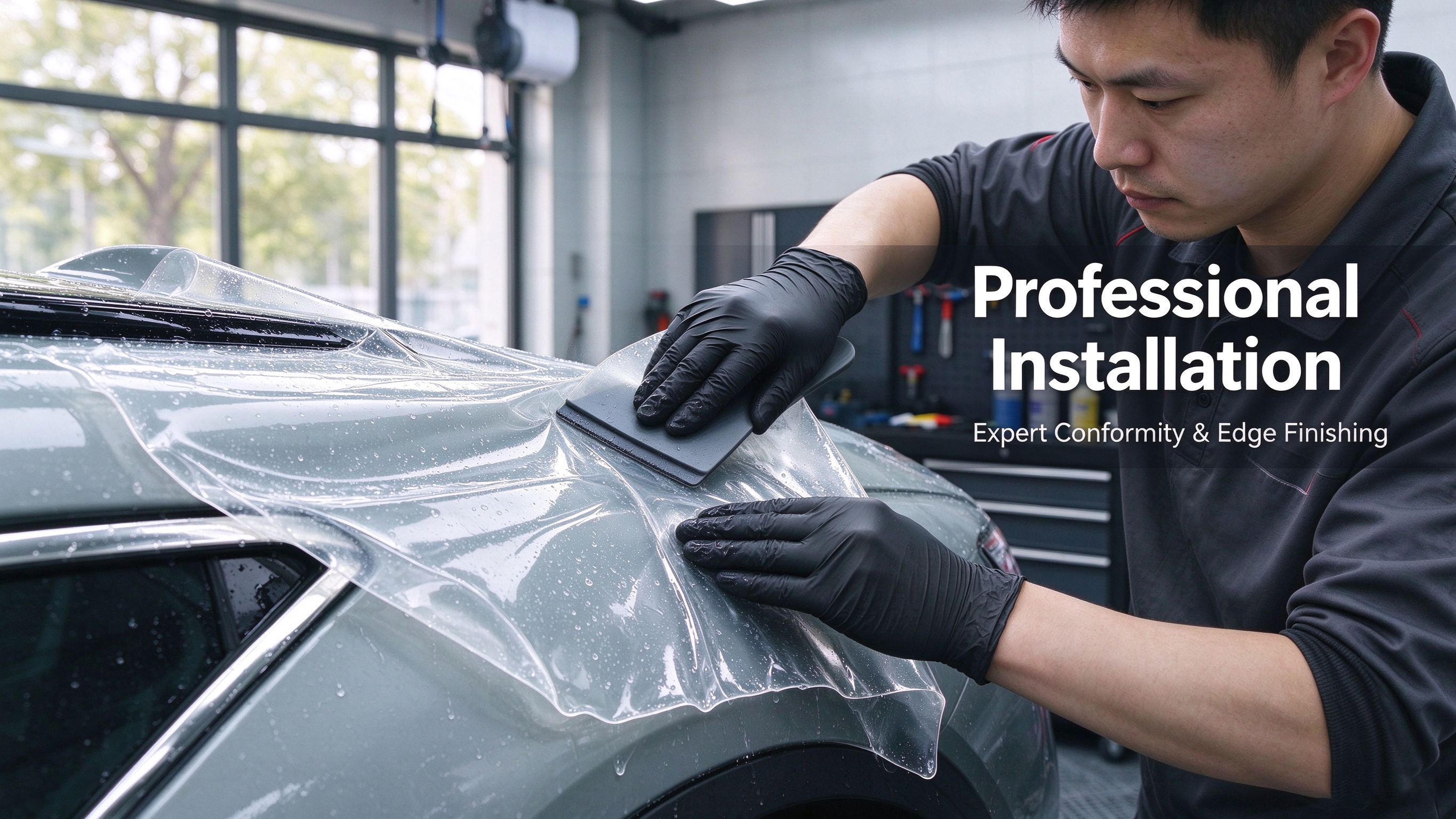
Where possible, have an experienced installer assess the product under realistic working conditions. Observe its handling, conformity, edge finishing, and appearance after installation.
Do not assume that adhesive strength alone determines quality. Installation behavior, appropriate bonding, and removal characteristics should be evaluated according to the product's intended use.
6. Check Appearance, Clarity, and Finish
For transparent PPF, buyers generally need to assess whether the film preserves the intended appearance of the vehicle's paint. For color PPF, color consistency and the intended finish become additional considerations.
Product photographs can provide an initial reference, but they may not reveal the full appearance of a film under different lighting conditions or after installation.
When evaluating a sample, consider:
-
Surface gloss or the selected finish.
-
Optical clarity for transparent films.
-
Visible texture, haze, or other surface irregularities.
-
Color consistency where applicable.
-
Appearance around edges and curved panels after installation.
Evaluate samples under consistent lighting and installation conditions when comparing different products. For color PPF, also confirm how the selected color or finish is specified and approved before placing a large order.
The goal is to assess whether the actual product meets the requirements of your market, not simply whether a photograph looks attractive.
7. Request Technical Data and Supporting Evidence
Technical claims are more useful when buyers can identify the documents and methods behind them.
Depending on the product and its intended application, relevant information may include a technical data sheet (TDS), safety documentation where applicable, installation guidance, and available test reports. Ask the supplier which documents can be provided for the exact model you are considering.
Depending on your requirements, you may need to investigate properties such as:
-
Thickness and dimensional consistency.
-
Adhesive performance.
-
Surface and stain resistance.
-
Weathering and UV-related performance.
-
Mechanical properties relevant to the intended application.
-
Other market-specific or customer-specific requirements.
Not every property needs the same test, and not every product needs the same set of documents. The important point is to identify what matters for your application and check whether the available evidence addresses it.
When reviewing a report, confirm the tested product, test method, conditions, and results. A general statement about a material or product family does not necessarily prove that every model has the same performance.
For importers and distributors, this step can also help identify documentation gaps before committing to a product range or making performance claims to customers.
8. Evaluate Samples Before Bulk Ordering
A sample is an opportunity to compare a product with your actual requirements before purchasing larger quantities.
Whenever possible, use a consistent evaluation process and involve an experienced installer. Record the conditions under which the film is applied so that comparisons are more meaningful.
A practical sample evaluation may include:
-
Checking the product label and confirming the model.
-
Comparing the supplied specifications with the quotation.
-
Assessing appearance and handling during installation.
-
Observing conformity and edge finishing on suitable test areas.
-
Recording any issues or questions for the supplier.
-
Confirming how the sample corresponds to the model intended for bulk production.
Sample evaluation does not guarantee that future production batches will be identical. Buyers should also understand the supplier's quality-control process and how consistency is managed between orders.
For distributors, testing samples before committing to larger quantities can support a more informed purchasing decision and help ensure that the product is appropriate for the intended customer group.
9. Review Warranty and After-Sales Support
Warranty coverage should be assessed for the specific product, not inferred from a general statement about a supplier's range.
Before ordering, confirm the applicable warranty period, covered issues, exclusions, maintenance requirements, and claim procedures in writing. Products in different series may have different terms.
You should clarify:
-
Which types of product defects or failures are covered?
-
What conditions or types of damage are excluded?
-
What evidence is required when submitting a claim?
-
How are claims assessed and resolved?
-
What responsibilities do the supplier, distributor, and installer each have?
Installation quality, vehicle condition, maintenance, environmental exposure, and the written warranty terms may affect how a claim is handled. Make sure these factors are clearly explained before committing to a product.
If you are selling under your own brand, confirm how the supplier's documented warranty terms fit the commitments you plan to make to your customers.
10. Match the Product to Your Market and Business Model
The right TPU PPF depends not only on technical characteristics but also on how you intend to sell and support the product.
A distributor supplying professional installers may prioritize installation behavior, repeat-order consistency, documentation, and a balanced product range. A brand owner may place more emphasis on specifications, packaging, brand identity, and the terms of a potential OEM or private-label arrangement.
Before making a decision, clarify the following commercial details:
| Factor | What to Confirm |
|---|---|
| Target application | Clear PPF, color PPF, or another suitable product |
| Specifications | Thickness, dimensions, finish, and model |
| Documentation | Available product data and relevant test evidence |
| Samples | Availability and evaluation arrangements |
| Quality control | Inspection procedures and batch consistency |
| Warranty | Product-specific terms and claim process |
| Order requirements | Minimum order quantity and available roll formats |
| Delivery | Lead time, payment, and agreed delivery terms |
| Customization | Available OEM or private-label options, costs, and requirements |
Not every buyer needs the same specification or commercial arrangement. Define your priorities first, then compare suppliers using the same criteria.
Frequently Asked Questions
What is the most important factor when choosing TPU PPF?
There is no single factor that determines overall suitability. Buyers should consider the complete film construction, thickness measurement, topcoat, adhesive, intended application, supporting evidence, and sample results together.
Is thicker TPU PPF always better?
No. Thickness alone does not establish overall quality or suitability. Confirm how the film thickness is measured, then assess it alongside installation behavior, flexibility, construction, and evidence relevant to the intended use.
How can I compare two TPU PPF products fairly?
Ask both suppliers for model-specific specifications and compare the same characteristics using consistent measurement units and definitions. Evaluate supporting documents and samples under comparable conditions, and clarify any differences in warranty or commercial terms.
Does all TPU PPF have self-healing properties?
No. Self-healing characteristics depend on the specific product's construction and topcoat. Buyers should confirm whether the selected model offers this feature, what types of marks it addresses, and what conditions are required.
What should I request before purchasing TPU PPF in bulk?
Request the exact product specifications, available technical documents, installation guidance, written warranty terms, and a sample where possible. Also confirm the minimum order quantity, roll dimensions, delivery arrangements, and any customization requirements.
Should distributors compare suppliers or products first?
Both are important, but begin by defining the product your market needs. Once you know the intended application and required specifications, you can compare suppliers more fairly on product evidence, quality control, supply arrangements, and after-sales support.
Conclusion: Choose TPU PPF Based on Evidence and Application
Choosing a TPU paint protection film requires more than looking at a product photograph, comparing a thickness number, or selecting the lowest quotation. Buyers should first define the intended application, understand the film construction, check how specifications are measured, and evaluate the topcoat, adhesive, appearance, and installation behavior.
Technical documents, sample evaluation, warranty terms, and supply arrangements help complete the picture. For distributors, importers, installers, and automotive film brands, using a consistent checklist can make product comparisons more meaningful and help reduce avoidable purchasing risks.
If you are exploring TPU PPF options for distribution, professional installation, or a private-label project, contact Guangdong Aici New Materials Co., Ltd. to discuss your requirements and request available product information. Sharing your target market, intended application, preferred specifications, and estimated order quantity will help the team understand your needs and identify suitable options for further evaluation.
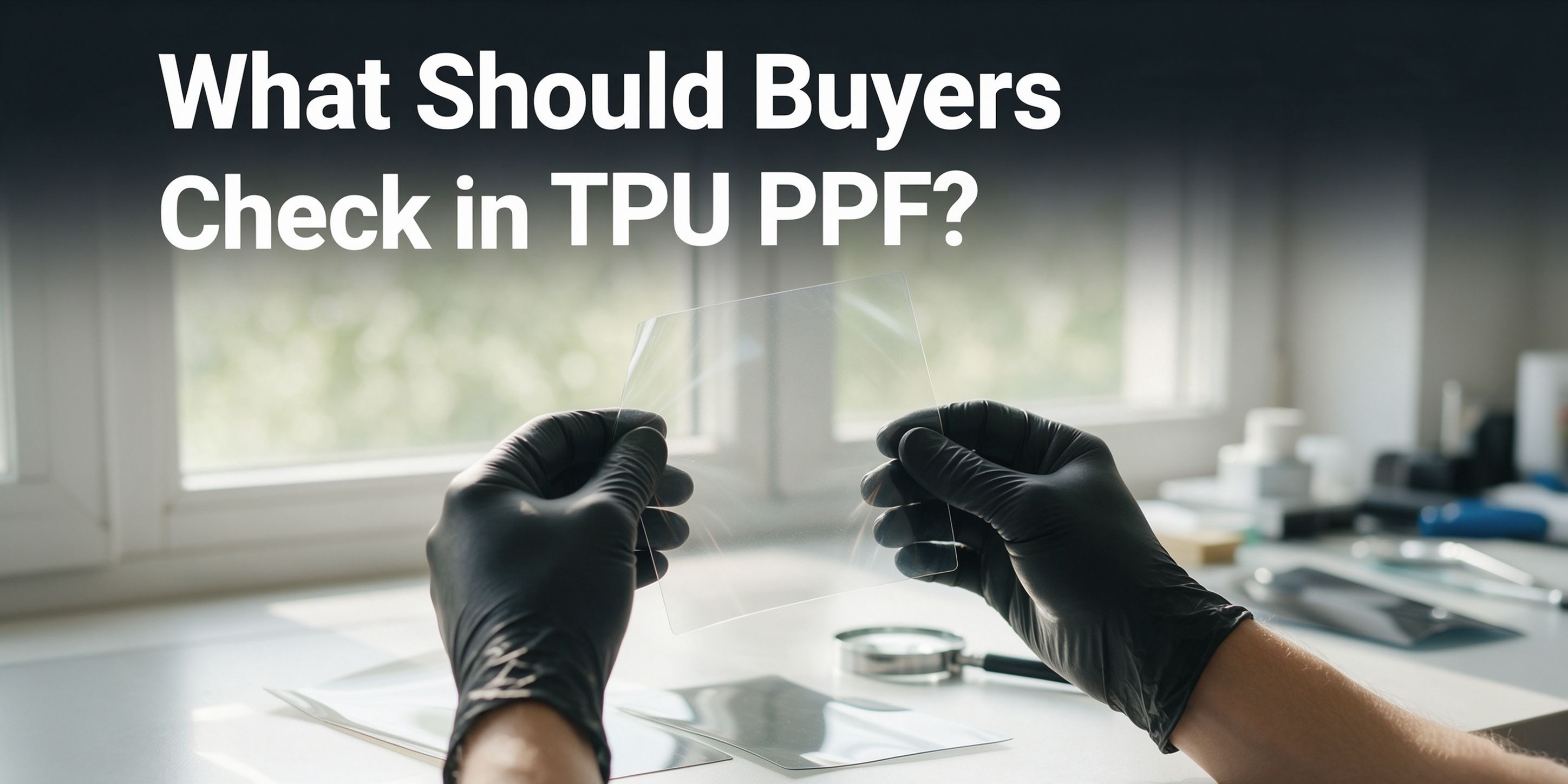
What Should Buyers Check in TPU PPF?