How to Maintain Glossy and Matte PPF: A Guide for Car Care Shops

Paint protection film (PPF) does more than protect a vehicle's original paint. It also plays an important role in maintaining the vehicle's overall appearance.
However, installing PPF is only part of the customer experience. Proper aftercare is equally important, especially when customers choose between glossy and matte finishes.
For professional PPF installers, detailing studios, and car care shops, explaining the correct maintenance methods can help customers avoid unnecessary damage, maintain the film's appearance, and build long-term trust in the service.
Although glossy and matte PPF share many basic cleaning requirements, their surface finishes require different care considerations. This guide explains how car care shops can maintain both types of film and provide practical aftercare advice to vehicle owners.
1. Understanding the Difference Between Glossy and Matte PPF
Before discussing maintenance, it is important to understand how these two finishes differ.
1.1 Glossy PPF
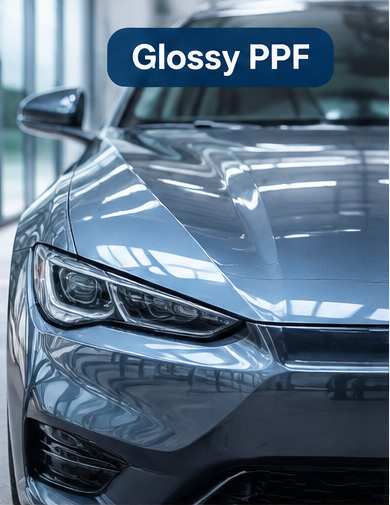
Glossy PPF provides a smooth, reflective appearance that enhances the vehicle's original paint finish.
Its highly reflective surface makes dirt, water spots, fingerprints, and certain surface marks easier to notice under direct lighting.
When maintaining glossy PPF, the main goals are to:
-
Keep the surface clean and clear.
-
Prevent water spots and contamination buildup.
-
Avoid scratches caused by improper washing.
-
Maintain a consistent glossy appearance.
1.2 Matte PPF
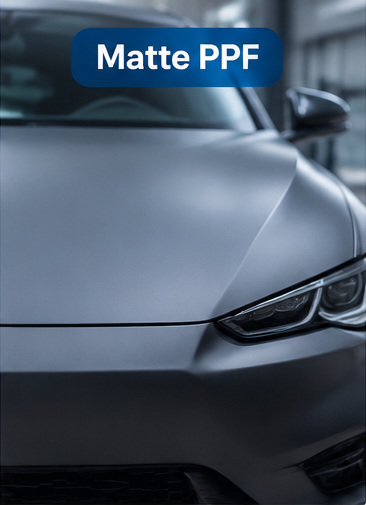
Matte PPF creates a non-reflective or low-reflective finish, giving the vehicle a more understated appearance.
Unlike glossy surfaces, matte finishes should maintain a consistent texture and sheen across the entire vehicle.
One important consideration is that polishing or using unsuitable glossy finishing products may create uneven shine or alter the intended matte appearance.
When maintaining matte PPF, the main goals are to:
-
Preserve the original matte or satin appearance.
-
Avoid polishing and abrasive cleaning.
-
Prevent uneven gloss patches.
-
Remove contamination without changing the surface finish.
1.3 Key Maintenance Differences
|
Maintenance Item |
Glossy PPF |
Matte PPF |
|---|---|---|
|
Regular washing |
Recommended |
Recommended |
|
Soft microfiber towels |
Recommended |
Recommended |
|
pH-neutral car shampoo |
Suitable if film-compatible |
Suitable if film-compatible |
|
Abrasive polishing |
Avoid unless manufacturer-approved |
Avoid |
|
Conventional wax |
Check product compatibility |
Avoid unless specifically approved |
|
Gloss-enhancing products |
Only if film-compatible |
Avoid unless specifically designed for matte finishes |
|
Water spot removal |
Use approved cleaning methods |
Use approved cleaning methods |
|
Surface inspection |
Check scratches and contamination |
Check scratches and uneven shine |
The key difference is not that matte PPF requires an entirely different washing process. Rather, it requires greater attention to preserving its original surface appearance.
2. How to Wash Glossy and Matte PPF Correctly
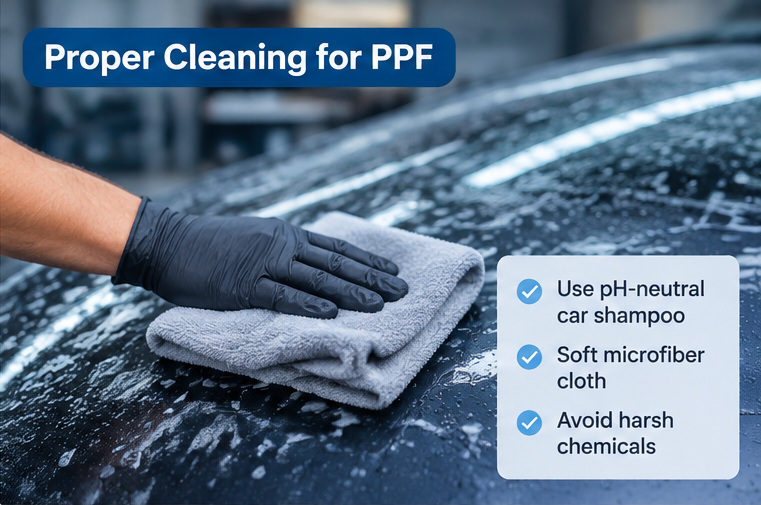
Regular washing is one of the most important parts of PPF maintenance.
For both finishes, professional car care shops should recommend gentle cleaning methods that remove dirt without causing unnecessary friction or damaging the film surface.
Step 1: Rinse Away Loose Dirt
Before touching the film with a wash mitt or towel, rinse the vehicle to remove loose dirt, sand, and other particles.
This step helps reduce the risk of dragging abrasive contaminants across the film.
If a pressure washer is used, avoid directing concentrated water pressure toward film edges, seams, or lifted areas.
Step 2: Use a Film-Compatible Car Shampoo
Choose a gentle car shampoo that is compatible with the specific PPF product.
A pH-neutral shampoo is a common choice for routine maintenance, but compatibility should always take priority over the pH label alone.
Avoid products containing aggressive chemicals or abrasive cleaning components unless the film manufacturer specifically approves them.
Step 3: Wash with a Soft Microfiber Mitt
Use a clean, soft microfiber wash mitt or another suitable non-abrasive washing tool.
Wash gently using straight movements rather than applying excessive pressure.
For professional detailing shops, using separate wash tools for heavily contaminated areas can help reduce the transfer of dirt across the vehicle.
Step 4: Rinse Thoroughly
After washing, rinse away all shampoo and remaining dirt.
Do not allow cleaning products to dry on the film, particularly when working outdoors or in warm weather.
Step 5: Dry with a Clean Microfiber Towel
Use a clean, soft, lint-free microfiber drying towel to remove remaining water.
An air blower can also help remove water from gaps, panel edges, and other difficult-to-reach areas.
Avoid aggressive rubbing or using dirty towels, as these can create unnecessary surface friction.
Professional tip: Whenever possible, wash vehicles in a shaded area after the bodywork has cooled down. This helps reduce rapid water evaporation and the formation of water spots.
3. How to Maintain Glossy PPF
Glossy PPF is designed to maintain a reflective finish. Its maintenance routine should focus on cleanliness, surface clarity, and avoiding unnecessary abrasion.
3.1 Remove Water Spots Promptly
Water spots can form when mineral-containing water evaporates and leaves deposits on the film surface.
If these deposits remain for too long, they may become more difficult to remove.
Recommended practices include:
-
Drying the vehicle after washing.
-
Avoiding washing under direct sunlight.
-
Removing fresh water spots with a film-compatible cleaner.
-
Seeking professional treatment if deposits become stubborn.
Do not immediately use abrasive polishing compounds to remove water spots.
3.2 Use Compatible Surface Protection Products
Some glossy PPF products are compatible with specific sealants or ceramic maintenance products.
These products may help with water behavior, cleaning, and maintaining the intended surface appearance.
However, not every coating or wax is suitable for every PPF product.
Before application, car care shops should:
-
Check the PPF manufacturer's maintenance instructions.
-
Confirm that the product is compatible with the film's topcoat.
-
Follow the recommended application procedure.
-
Test the product in an inconspicuous area when required.
Avoid assuming that products designed for conventional automotive paint are automatically suitable for PPF.
3.3 Avoid Excessive Polishing
Glossy PPF should not be treated exactly like conventional automotive paint.
Abrasive compounds and aggressive polishing techniques can affect the film's surface coating.
If the film has visible contamination or surface defects, identify the cause before attempting correction.
Use only manufacturer-approved maintenance or correction procedures.
4. How to Maintain Matte PPF
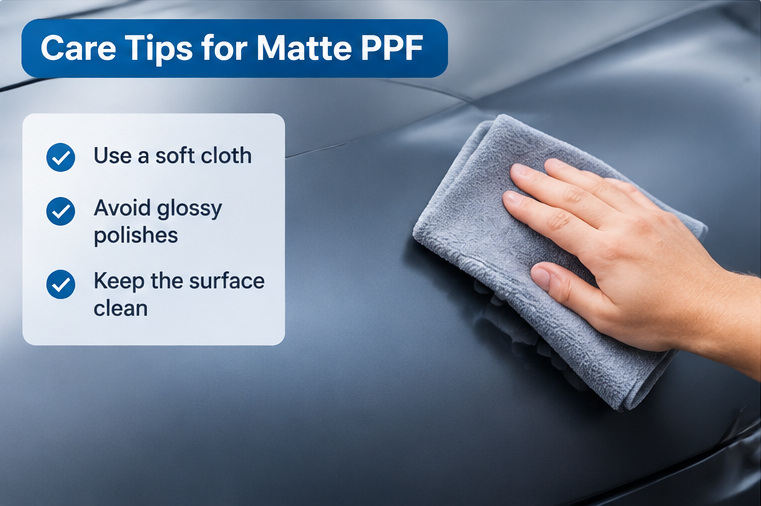
Matte PPF requires particular attention because its appearance depends on maintaining a consistent non-glossy or satin surface.
4.1 Avoid Conventional Polishing
One of the most important rules when maintaining matte PPF is to avoid conventional polishing.
Polishing compounds are designed to refine or enhance surface appearance. On matte film, they may create glossy spots or uneven reflections.
If a matte surface develops contamination or visible marks, do not immediately attempt to polish the affected area.
Instead, identify the issue and follow the manufacturer's recommended cleaning procedure.
4.2 Choose Matte-Compatible Cleaning Products
Not every automotive detailing product is suitable for matte finishes.
Avoid using products that are specifically designed to increase gloss unless the manufacturer confirms compatibility with the particular matte PPF.
When selecting cleaning products, look for:
-
Compatibility with matte or satin PPF.
-
Non-abrasive cleaning properties.
-
No unwanted gloss-enhancing ingredients.
-
Clear application and removal instructions.
Using the wrong maintenance product may affect the appearance of the film even if it does not cause obvious physical damage.
4.3 Clean Gently and Evenly
When washing matte PPF, use a soft microfiber mitt and gentle pressure.
Avoid aggressive spot cleaning that repeatedly concentrates friction on one small area.
If a stain requires additional attention, use a compatible cleaner and follow the product instructions.
The objective is to remove contamination while preserving a uniform surface appearance.
4.4 Watch for Uneven Shine
Uneven shine is one of the appearance issues that matte PPF owners should watch for.
It may result from:
-
Incompatible wax or detailing products.
-
Localized polishing.
-
Excessive rubbing.
-
Uneven product application.
-
Surface contamination.
If a section of matte PPF appears noticeably glossier than the surrounding area, inspect the surface before applying additional products.
Do not attempt to correct the difference with random polishing or chemical treatments.
5. How to Remove Common Contaminants from PPF
Vehicles encounter different types of contamination during everyday driving.
Some contaminants should be removed quickly to reduce the risk of staining or surface damage.
|
Contaminant |
Recommended Approach |
Important Note |
|---|---|---|
|
Bird droppings |
Soften with water and a compatible cleaner, then gently remove |
Avoid scraping |
|
Insect residue |
Use a film-compatible insect remover |
Do not leave it on the surface for long |
|
Tree sap |
Use an approved sap remover |
Avoid aggressive solvents |
|
Road tar |
Use a PPF-compatible tar remover |
Follow the manufacturer's instructions |
|
Water spots |
Use an approved water spot cleaner |
Avoid abrasive correction |
|
Road dust |
Rinse before contact washing |
Prevent particles from scratching the surface |
|
Fuel spills |
Clean promptly using the film manufacturer's recommended procedure |
Do not allow fuel to remain on the film |
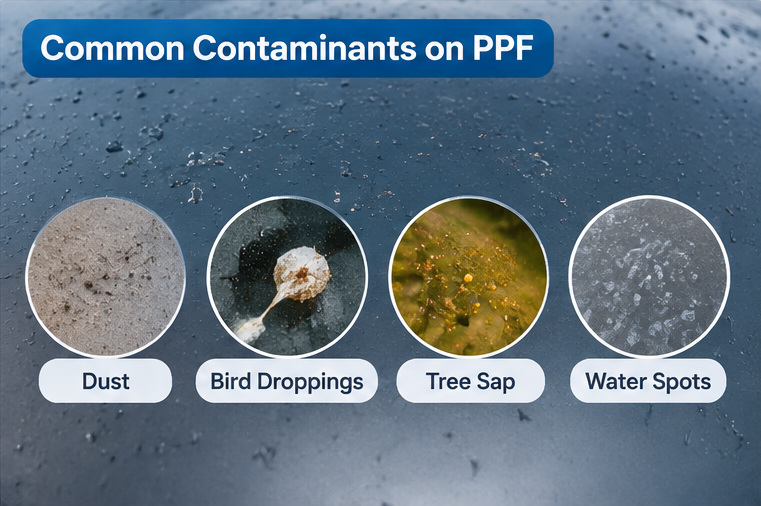
For both glossy and matte PPF, the safest approach is to identify the contaminant first and select a suitable cleaning method.
Using one aggressive chemical for every type of stain can create unnecessary risks.
If contamination cannot be removed using routine cleaning methods, professional assessment is recommended.
6. Common PPF Maintenance Mistakes Car Owners Should Avoid
Even high-quality PPF can experience appearance problems if it is maintained incorrectly.
Car care shops should explain the following common mistakes to customers.
Mistake 1: Using Automatic Brush Car Washes
Brush-based car washes can create friction and may introduce scratches or affect film edges.
Hand washing is generally the preferred option.
If an automatic wash is necessary, a touchless system is a better alternative, provided its cleaning chemicals are compatible with the film.
Mistake 2: Using Harsh Chemicals
Strong chemicals, unsuitable solvents, and abrasive cleaners may damage the film's surface or affect its appearance.
Always check product compatibility before use.
Mistake 3: Scrubbing Stains Too Aggressively
Repeatedly rubbing a contaminated area with a rough towel can create unnecessary abrasion.
Soften the contamination first and use an appropriate cleaning product.
Mistake 4: Applying the Same Wax to Glossy and Matte PPF
A product that is suitable for glossy PPF may not be suitable for matte PPF.
Some waxes and detailing products can change the appearance of matte surfaces.
Always distinguish between the two finishes when recommending maintenance products.
Mistake 5: Ignoring Film Edges
Film edges and seams deserve particular attention during washing.
High-pressure water directed toward these areas may contribute to lifting.
If an edge begins to lift, customers should return to the original installer for inspection rather than attempting to press it back down themselves.
7. Recommended PPF Maintenance Schedule for Customers
A simple maintenance schedule can help vehicle owners develop consistent cleaning habits.
The following is a general example that car care shops can adapt according to the film manufacturer's instructions, driving conditions, and local environment.
|
Frequency |
Recommended Maintenance |
|---|---|
|
After driving in heavy contamination |
Rinse or clean affected areas when appropriate |
|
Every 1–2 weeks |
Perform a routine vehicle wash, depending on usage and conditions |
|
After every wash |
Dry the film and inspect for remaining contamination |
|
Every month |
Check visible film areas, edges, and seams |
|
Every 3–6 months |
Review the film's overall appearance and assess whether approved maintenance products are needed |
|
When unusual marks appear |
Inspect and identify the cause before attempting correction |
This schedule is a practical starting point, not a universal manufacturer requirement.
The ideal maintenance frequency depends on factors such as driving habits, weather, parking conditions, and exposure to road contaminants.
8. Aftercare Advice Every PPF Shop Should Give Customers
For professional installers and car care businesses, customer education should be part of the service.
Before handing the vehicle back, explain the following points:
Immediately after installation
-
Follow the installer's recommended waiting period before the first wash.
-
Avoid disturbing the film edges during the initial adhesion period.
-
Contact the installer if unusual lifting or installation-related issues appear.
During regular use
-
Wash the vehicle with compatible cleaning products.
-
Use soft microfiber washing and drying tools.
-
Remove bird droppings, insect residue, and other contaminants promptly.
-
Avoid aggressive scrubbing and abrasive products.
-
Keep high-pressure water away from film edges.
For matte PPF owners
-
Do not use conventional polishing compounds.
-
Avoid ordinary gloss-enhancing waxes and products unless specifically approved.
-
Choose maintenance products designed for compatible matte or satin finishes.
For glossy PPF owners
-
Use compatible surface maintenance products when needed.
-
Avoid unnecessary abrasive polishing.
-
Keep the surface clean and dry to reduce water spot buildup.
Providing customers with a simple written aftercare guide can also reduce misunderstandings and encourage them to return for professional maintenance.
9. Frequently Asked Questions About Glossy and Matte PPF Maintenance
Q1: Is matte PPF more difficult to maintain than glossy PPF?
Not necessarily. Both finishes require regular cleaning and appropriate maintenance. However, matte PPF needs additional care when selecting waxes, coatings, and detailing products because unsuitable products may change its surface appearance.
Q2: Can I use regular car shampoo on PPF?
Many conventional car shampoos can be suitable, provided they are compatible with the specific film. Avoid abrasive or aggressive cleaning products and follow the manufacturer's recommendations.
Q3: Can matte PPF be waxed?
Some products are specifically formulated for matte or satin finishes. However, conventional gloss-enhancing waxes should not be used unless the PPF manufacturer confirms compatibility.
Q4: Can I polish glossy PPF to remove scratches?
Do not assume that conventional paint polishing methods are safe for PPF. Abrasive polishing may damage the film's topcoat. Follow the manufacturer's approved correction procedures.
Q5: How soon can a vehicle be washed after PPF installation?
The recommended waiting period varies by product and installation conditions. Some manufacturers specify 48 hours, while others recommend 72 hours or longer. Always follow the specific installation and aftercare instructions.
Q6: Can I use a pressure washer on PPF?
It may be possible when the manufacturer permits it and the correct operating conditions are followed. Avoid directing concentrated water pressure toward film edges, seams, or lifted areas.
Q7: What should I do if matte PPF develops glossy patches?
First, identify whether the patches are caused by contamination, product residue, or surface changes. Use only approved cleaning methods. If the appearance does not return to normal, consult the film manufacturer or professional installer.
Conclusion
Proper maintenance is essential for keeping both glossy and matte PPF looking their best.
While the basic washing process is similar, the two finishes require different considerations when selecting detailing products and treating surface contamination.
For car care shops and professional installers, providing clear aftercare instructions is an important part of delivering a complete PPF service.
By understanding the differences between glossy and matte finishes, recommending compatible cleaning products, and helping customers avoid common maintenance mistakes, businesses can improve the ownership experience and build stronger long-term customer relationships.
At Guangdong Aici New Materials Co., Ltd. (AICI), we specialize in TPU Paint Protection Film, TPU Color PPF, and PVC Color Change Film. With 16 years of industry experience, we focus on manufacturing quality control and supporting overseas automotive film partners.
If you are looking for automotive film products for your distribution or installation business, feel free to contact our team to discuss your requirements.
How to Find a Reliable TPU PPF Manufacturer in China: 8 Things Buyers Should Check
Preventing PPF Edge Lift: A Practical Guide for Installers