How OEM and Private-Label Automotive Film Manufacturing Works
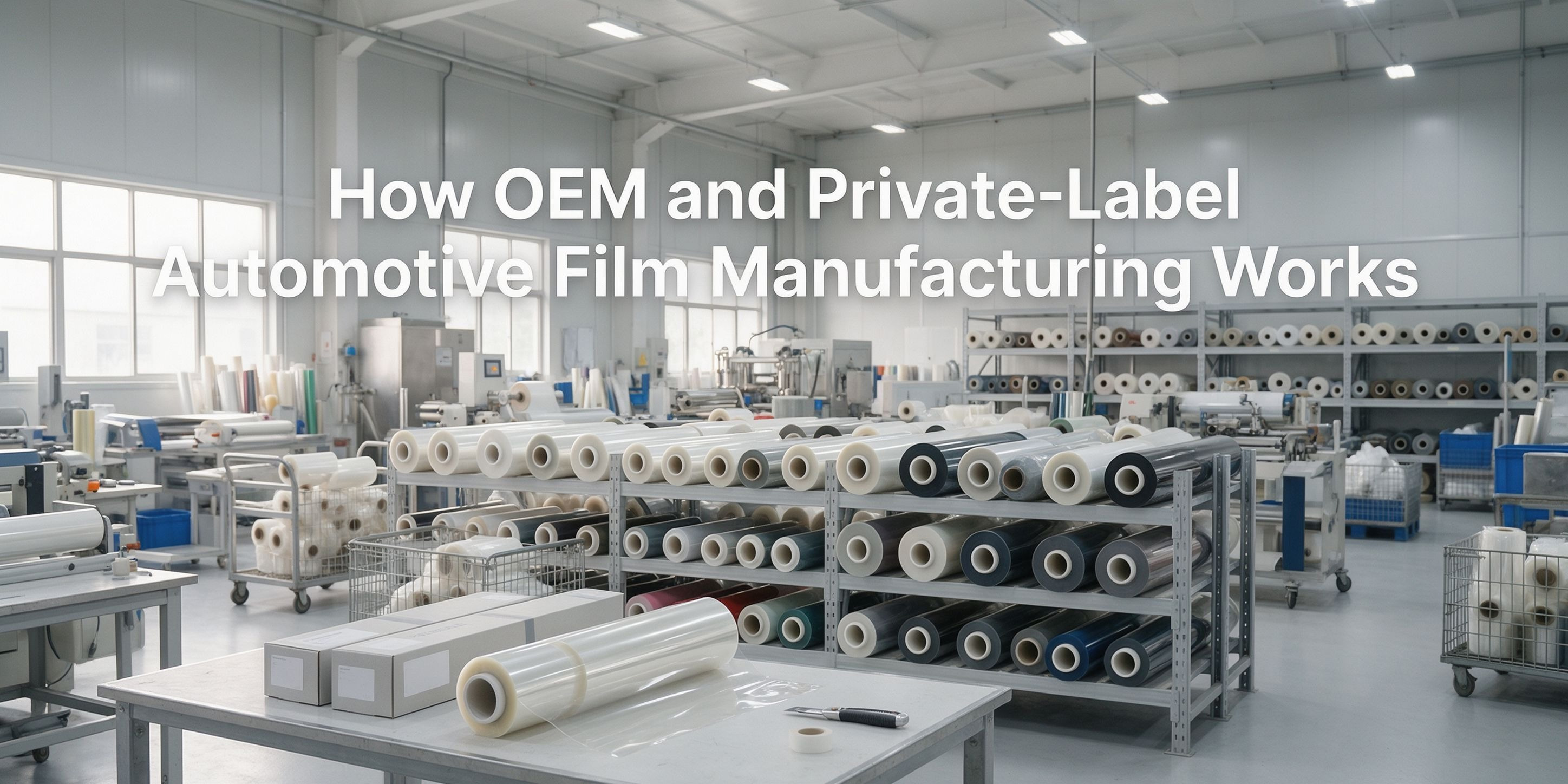
Building an automotive film brand does not necessarily require owning a manufacturing facility. For distributors, importers, wholesalers, and entrepreneurs, working with an experienced automotive film manufacturer can be a practical way to develop a branded product line.
OEM and private-label programs allow businesses to source automotive films under their own brand identity, with the level of customization depending on the supplier and agreement.
The main difference is that private labeling often focuses on branding existing products, while OEM cooperation can involve manufacturing products to a buyer's defined specifications. In some cases, these services overlap, so buyers should confirm exactly what a supplier includes in its OEM or private-label program.
From product selection and sample testing to packaging, quality control, and bulk ordering, understanding the process helps businesses make better sourcing decisions.
1. What Is OEM Automotive Film?
OEM stands for Original Equipment Manufacturer. In the automotive film aftermarket, the term is also commonly used in supplier discussions to describe manufacturing products according to a customer's requirements and brand specifications.
Under this type of arrangement, the buyer works with a manufacturer to define the product requirements and commercial conditions.
Depending on the manufacturer's capabilities, the project may involve:
-
Selecting or developing a particular automotive film product.
-
Defining material, thickness, finish, dimensions, or other specifications.
-
Applying the buyer's brand identity to the film or packaging.
-
Establishing product inspection requirements and documentation.
-
Agreeing on production quantities, delivery schedules, and commercial terms.
The scope of OEM services varies by manufacturer. Some suppliers can only customize standard products and packaging, while others may offer broader product development and specification adjustments.
Buyers should confirm which parts of the product can actually be customized before assuming that an OEM service includes changes to the film's formulation or performance.
2. What Is Private-Label Automotive Film?
Private-label automotive film is a product sold under a brand owned or controlled by the buyer, while manufacturing is handled by an external supplier.
For example, a distributor may select a manufacturer's existing TPU paint protection film, choose an available finish, and sell it under the distributor's own brand with customized labels and packaging.
Depending on the supplier's services, private-label options may include:
-
Brand logos and product labels.
-
Custom roll boxes and outer cartons.
-
Product names and SKU systems.
-
Color charts, sample cards, and swatch books.
-
Selected roll dimensions or packaging configurations.
-
Branded marketing materials.
Private labeling can be a practical starting point for businesses that want to establish a brand without investing in their own production equipment.
However, private labeling does not automatically mean that a product is exclusive to one buyer. Other businesses may be able to source the same standard product from the same manufacturer.
If exclusivity matters to your business, discuss the relevant products, territories, duration, and contractual conditions with the supplier before placing an order.
3. OEM vs. Private Label: What Is the Difference?
The terms may overlap in the automotive film industry, but they often describe different levels of customization.
| Comparison Factor | OEM Cooperation | Private Label |
|---|---|---|
| Product basis | May use buyer-defined specifications or an agreed product design | Often starts with an existing product |
| Product customization | Depends on the manufacturer's technical capabilities | Usually focuses on branding, packaging, and product selection |
| Branding | Buyer's brand can be applied as agreed | Buyer's brand is used on the selected product |
| Development requirements | May involve additional technical discussion, samples, and validation | Can be simpler when standard products are used |
| Initial project complexity | May be higher for customized specifications | Often more straightforward for standard products |
| Production quantities | Depend on the product and customization requirements | Depend on the product, packaging, and supplier's MOQ |
| Best suited for | Businesses seeking defined product specifications or product differentiation | Businesses launching or expanding a branded product range |
These are general distinctions rather than universal definitions. A supplier may use the term OEM to describe custom branding, while another may reserve it for manufacturing to specific technical requirements.
Before signing an agreement, ask the manufacturer to define the exact scope of OEM, ODM, and private-label services in writing.
4. Which Automotive Film Products Can Be Considered?
The available product range depends on the manufacturer's capabilities and its existing portfolio.
For automotive film businesses, possible categories include:
TPU Paint Protection Film
TPU PPF is designed to protect vehicle paint. Buyers may evaluate clear PPF or colored PPF according to their target market, required specifications, and customer demand.
If a project requires particular thicknesses, surface finishes, adhesive characteristics, or performance claims, these requirements must be confirmed with the manufacturer and supported by appropriate technical documentation.
Color Change and Vinyl Wrap Films
Vehicle wrapping films are used primarily for color customization and styling. Different product ranges may offer gloss, satin, matte, metallic, or textured finishes.
When building a private-label range, buyers should consider the colors customers request most frequently and whether a manageable initial selection would be more practical than launching too many products at once.
Automotive Window Film and Other Film Products
Depending on the supplier's capabilities, a broader automotive film program may also include window film, headlight film, or other related products.
However, not every manufacturer produces every category. Buyers should verify which products the supplier manufactures directly and which, if any, are sourced from other factories.
The right product portfolio depends on your business model, customer base, market requirements, and available investment.
5. How Does an OEM or Private-Label Project Work?
A structured process helps both parties understand the requirements before production begins.
Step 1: Define Your Market and Product Requirements
Start by identifying your target customers, sales channels, and intended price positioning.
For example, an importer serving professional PPF installers may have different priorities from a distributor selling color-change films to wrapping shops.
Prepare a brief that includes:
-
Target market and customer profile.
-
Product categories and intended applications.
-
Desired product specifications and finishes.
-
Estimated order quantity.
-
Target pricing and commercial requirements.
-
Branding and packaging preferences.
A clear brief helps the manufacturer determine whether its existing products and production capabilities are suitable.
Step 2: Select the Product and Confirm Specifications
After discussing your requirements, compare the manufacturer's available products and technical information.
Check relevant details such as material construction, stated thickness, roll dimensions, surface finish, adhesive system, and documented performance.
Do not rely solely on product photographs or general marketing descriptions. Request technical data sheets and clarification of any specifications that are important to your market.
If you require a genuinely customized product, ask which specifications can be changed, what technical limitations apply, and whether additional development work is necessary.
Step 3: Request Samples and Evaluate Performance
Before committing to a large order, request samples where available.
For PPF, consider the characteristics that matter to the intended application, such as surface appearance, installation behavior, adhesion, and the specific protective properties supported by technical documentation.
For vinyl wrapping films, evaluate color accuracy, surface finish, conformability, installation behavior, and the resulting appearance on the intended substrate.
Whenever possible, arrange for qualified installers to evaluate the sample under realistic working conditions.
A sample review also gives both parties an opportunity to agree on the expected product appearance and acceptance criteria before bulk production.
Step 4: Confirm Branding and Packaging
Once the product direction is agreed upon, confirm the branding details.
Depending on the supplier's capabilities, this may include logos, product labels, roll boxes, outer cartons, product codes, barcodes, color charts, and sample books.
Before production, approve the final artwork and confirm the required dimensions, text, colors, and labeling information.
If the film itself will carry printed branding, ask the manufacturer to confirm the available printing method, placement, and approval process.
Branding requirements should be documented separately from technical product specifications to reduce the risk of errors.
Step 5: Agree on Quality Control and Acceptance Criteria
Quality control should be discussed before the bulk order is placed, not only after the goods arrive.
Agree on the product specifications, inspection requirements, packaging standards, batch identification, and procedure for reporting nonconforming products.
Depending on the product, relevant checks may include visual appearance, dimensions, consistency between rolls, adhesion-related characteristics, or specific performance tests.
Ask what inspection records or technical documents the manufacturer can provide. If independent testing is necessary, agree on the test methods and acceptance criteria in advance.
Avoid relying on broad claims such as "premium quality" without measurable requirements or supporting documentation.
Step 6: Confirm Commercial Terms and Start Production
Before approving production, confirm the purchase order and the key commercial details.
These may include minimum order quantity (MOQ), unit price, payment terms, production lead time, packaging costs, shipping arrangements, and responsibility for additional charges.
The manufacturing schedule should be confirmed against the final approved specifications, sample, and artwork.
Changes made after approval may affect cost and delivery timing, so establish a clear process for handling revisions.
After production, review the agreed documentation and shipment details, and keep purchase records and batch information for future orders or quality-related discussions.
6. How Should You Choose an Automotive Film Manufacturing Partner?
The right partner is not necessarily the supplier offering the lowest quotation. Consider the following factors when evaluating potential manufacturers.
Manufacturing Capability
Confirm whether the supplier manufactures the relevant film or purchases finished products from another producer.
Ask about the production processes, product categories, customization capabilities, and which operations are performed in-house.
If factory ownership or direct manufacturing is important to your business, verify the claim rather than relying on a general "factory direct" description.
Technical Documentation
Request the available technical data sheets, product specifications, test reports, and relevant compliance documents.
The documents should correspond to the actual product and model being quoted. If certification or market-specific compliance is required, confirm its applicability before ordering.
Quality Consistency
Ask how the manufacturer identifies production batches, checks finished rolls, records inspection results, and handles customer complaints.
Consistent product specifications and traceability are especially important when your brand depends on repeat orders.
Communication and After-Sales Support
Evaluate whether the supplier answers technical questions clearly and provides a defined process for addressing product issues.
For a brand owner, after-sales support can affect distributor confidence, customer satisfaction, and the ability to investigate recurring problems.
Commercial Transparency
Compare quotations on a like-for-like basis.
Check whether the prices cover the same specifications, roll dimensions, packaging, quantities, and shipping terms. A low quotation may exclude customization or other costs that appear later.
7. What Should You Know About MOQ, Lead Time, and Exclusivity?
Three commercial questions deserve particular attention before starting a private-label project.
Minimum order quantity (MOQ): MOQ depends on the film, product configuration, order size, and level of customization. Customized packaging or new product development may create different requirements from a standard product order. Always request the MOQ for your specific project.
Lead time: Production timing depends on product availability, order volume, sample approval, artwork approval, and any customization work. Ask the supplier to provide a schedule based on the actual project rather than relying on a general estimate.
Exclusivity: Private labeling does not automatically provide exclusive rights to a film or product specification. If you require territory-based, channel-based, or product-specific exclusivity, define it clearly in a written agreement and clarify any applicable conditions.
You should also discuss ownership and permitted use of logos, packaging artwork, custom specifications, and any separately developed designs.
These agreements help clarify responsibilities and reduce the likelihood of misunderstandings as the business grows.
8. Frequently Asked Questions
What is the difference between OEM and private-label automotive film?
OEM cooperation may involve manufacturing to a buyer's defined specifications, while private labeling often involves selling an existing product under the buyer's brand. Definitions vary among suppliers, so the actual scope should be confirmed in writing.
Can I sell automotive film under my own brand without owning a factory?
Yes. A business can work with a third-party manufacturer to produce or supply film under its own brand, subject to the supplier's services and the agreed commercial terms.
Can I customize the product specifications and packaging?
Possibly. Customization depends on the manufacturer's capabilities, the product category, order quantity, and project requirements. Confirm the available options and additional costs before approving the order.
Do OEM and private-label automotive film projects have an MOQ?
MOQ requirements vary by product and supplier. Standard products may have different order requirements from customized products or packaging. Request a project-specific quotation.
Should I order samples before placing a bulk order?
Yes, when samples are available. Testing samples helps evaluate appearance, installation behavior, and the product characteristics important to your market before committing to a larger purchase.
Does private-label automotive film guarantee product exclusivity?
No. Private labeling alone does not guarantee exclusivity. Any exclusive rights should be defined clearly in the agreement, including the products, territory, duration, and applicable conditions.
What information should I send a manufacturer when requesting a quotation?
Provide your target market, product category, key specifications, desired finishes, estimated quantity, branding requirements, packaging preferences, and destination country. The more clearly the requirements are defined, the easier it is for the manufacturer to prepare a relevant quotation.
Conclusion: Build Your Brand on Clear Requirements and Reliable Cooperation
OEM and private-label automotive film programs can help importers, distributors, wholesalers, and brand owners develop their own product lines without necessarily investing in manufacturing equipment.
The most important step is to define what you need before placing an order. Product specifications, sample approval, branding, quality control, MOQ, lead time, and commercial terms should all be discussed and documented.
A successful manufacturing partnership is about more than putting a logo on a box. It requires a clear understanding of the product, consistent quality expectations, transparent communication, and a process for handling future orders.
Planning to develop your own automotive film brand? Contact AICI to discuss your target market, product requirements, and potential cooperation options. Confirm the available OEM or private-label services, product specifications, minimum order quantity, and commercial terms with the AICI team before proceeding.
Private Label PPF Manufacturer: How to Start Your Own Paint Protection Film Brand
TPU PPF Wholesale Price: What Affects the Cost per Roll?